
The Real Production Market: 500 CHATS, 5 Truths
We’ve all seen the LinkedIn posts. The ones about "paradigm shifts in the content ecosystem." The "strategic frameworks" and "innovative operating models." The declarations about "revolutionising" this or "transforming" that…But what does it all actually mean for companies trying to build their businesscapabilities with producers at the centre? How does it affect producers trying to decide their next move? Or a freelancer wondering which skills to develop? We all love a bit of thought leadership, but a lot of it contains nothing concrete, actionable, or, in some cases, fathomable.
Loads of people are asking me what I predict for 2026. What do I know? what do any of us know - look at the last 26 days of the year so far! All I can do is I continue to map the production market. For the past six years running Curious Connections, I’ve been tracking who's moving where, what skills are in demand, where gaps are opening up, and what's actually happening beyond the LinkedIn announcements, word salads and humble brags. I’ll just share my perspective and hope to hear some comments and continue chatting and discussing. Because I do see a lot from my vantage point as a recruiter. I work with arguably the best agencies, production companies and post houses in London, and I hear things all the time that helps me gather a view about things are headed -
Most recruiters are reactive. A client calls with a role, they search their database, post on LinkedIn, send some CVs, hope for the best. They're order-takers. I spent 25 years as a runner, producer, head of production, and MD at agencies like Mother, BBH, Saatchi & Saatchi and production companies like RSA, Stink, and Outsider. I didn't leave that world to become a transactional recruiter. I left to apply everything I learned about how production actually works - and combine it with up-to-date intelligence about where the market is going. I’ve also walked in those producer shoes for decades, I understand how the shifts affect people, as well as the bottom line on the balance sheet.
So when I talk about 2026, I'm not speculating. I'm not creating "frameworks" or "paradigms." I'm simply distilling hundreds of conversations with producers, creative teams, production companies, agencies, and brands and sharing with you the patterns I see in who's hiring, who's moving, what skills are commanding premiums, and where the actual opportunities live.
No jargon. No word salad. Just a view, yours to ignor of course.
1. Why Brands Need To Get Serious About Their Prodcer Hires.
1. Why Brands Need To Get Serious About Their Prodcer Hires.
All over the industry trades we read about all the amazing creatives who are moving over to the "other side" - the IN HOUSE at brand side. They are winning awards and making big impact. But I want to say to several brands - “ you're hiring award-winning creatives, but your production hires aren't matching that ambition” .2026 is the year I want to change that.
Scroll through LinkedIn right now and look at the producer job ads brands are posting. They read like project management roles. "Oversee operational aspects." "Timeline estimation and cost tracking." "Managing high volumes of visual assets efficiently." "Thrives on logistics." These are the job descriptions you'd write if you were hiring someone to manage a workflow, not someone to make extraordinary work.
The producers who could genuinely partner with your award-winning creatives aren’t going to respond to those ads, they might be ideal - they have experience at the best agencies, studios and production companies and make brilliant work. No producer, with the pedigree of the creatives you are hiring, would even finish reading that listing, .Because these specs tell them everything they need to know - you're looking for an administrator, not a creative producer.
Don’t get me wrong I love a bit of corporate rigour and admin points - the budget tracking, the timeline management, the workflow optimisation - they're massively important no matter the size of the company. Any producer worth their salt needs to deliver on those fundamentals. But they should be part of the remit, not the thrust of the hire.
When that's all you're leading with, you're screening out exactly the talent you need.
The creatives you're hiring aren't just coming with ideas - they're coming with relationships and frames of reference. They know the directors, the DOPs, the editors who can execute at the highest level. They can talk about visual references, lighting techniques, design inovations and performance nuances. They're used to working with producers who are equally fluent in that language, who can challenge them creatively while protecting the work, who have their own black book of world-class HODs and partners and can command respect and influence with all the main stakeholders.
I urge you to go on linkedin and just look for a job ads for a brand producer: barely any mention of creative judgement, Understanding of craft., Visual sensibility. The ability to identify and work with the best talent. Knowledge of what makes great work actually great. Instead it's all about "resource allocation," "managing workflows," and "tracking budgets”
No shade on the current in-house brand producers! - many are excellent at keeping projects on track, on budget, and delivered on time and many deliver all the stuff I mention without realising it and without being asked. But if you want to make the really stellar work that your new creative hires are capable of - the kind that wins awards and transforms brands - you need a fundamentally different type of producer. You need someone who's committed to the work itself, not just the process. Someone who can talk about lighting or why a particular editor would be perfect for this job. Someone whose first question isn't "what's the timeline?" but "what are we trying to make here?"
The recent IHALC survey identified a key risk for in-house teams: creative stagnation."Without fresh inputs, there's a risk of creative stagnation. Unlike external agencies, in-house teams don't benefit from the natural cross-pollination that comes from working across multiple brands.
The producers who've come up through top agencies and production companies? They ARE that fresh input. They bring the craft standards, the creative networks, and the production excellence that keeps work from becoming commoditised.
HOWEVER - Not every producer with that craft pedigree will thrive in a brand environment - I will continue to say throughout 2026 "working in-house is not right for everyone." It's not just about talent and skills; it's also about the right temperament and willingness to navigate corporate structures while maintaining creative standards. That's the challenge.
After five years of helping the most creative award-winning companies build their production capabilities, I've learned that the difference between good hiring and great hiring starts before the recruitment process even begins - it starts with how we define what is actually needed. When companies focus solely on operational skills in their job producer descriptions (timelines, budgets, stakeholder management), they attract operational candidates. When they articulate the creative ambition and craft standards they're aiming for, they attract a different calibre of applicant entirely. And that remit endures. So many of the producers sitting in-house could add so much more creative allyship, but it’s not in their remit - what a waste!
But getting that balance right in a job spec is harder than it sounds. Too much emphasis on craft and you'll scare off candidates who can actually navigate corporate structures. Too much emphasis on operations and you'll attract people who manage timelines beautifully but can't elevate the work. I've spent hours with hiring managers unpicking what they really need, versus what they think they should ask for - and it makes all the difference to who applies and who succeeds.
If you're building or rebuilding your in-house production capability and want to avoid the hire-rehire cycle, let's talk before you post that job description. Getting the brief right is half the battle, At least let me write your JD I can help!
(Coming soon: a case study on a recent brand-side search where getting this balance right took three drafts of the job spec - and resulted in a hire who's still thriving! )
Because if you want your in-house team to be "at the centre of everything" and deliver award-winning work, you need to give your brilliant creatives, the production partners they can partner with - not just someone who's good at Sage.
And if you're wondering where to find these producers, or how to identify who has both the creative pedigree and the adaptability to thrive brand-side? That's exactly the conversation I have with all my clients. I’ve walked in the shoes of producers from all different settings, I know the difference, this isn’t theory, it’s lived experience harnessed by. new perspective.
So here's my challenge to brands hiring producers in-house in 2026: rewrite your producer job specs. I will help you, no strings!
2. The Branded Entertainment Boom
2. The Branded Entertainment Boom
The traditional advertising model is creaking. Brands can't reach audiences through TV ads alone anymore, so they're creating their own entertainment. But Branded is more than buzz.
The big global TV production players are already on it: Banijay, ITV and all the major studios have entire departments built around this. But for London agencies and production companies? There's still a massive skills gap - particularly around development, distribution strategy and funding models for scripted and non-scripted IP..
For all my time in this industry, the two beams of broadcast production and ad production never crossed. Now they're intersecting - and most companies can’t have the expertise in-house to navigate both sides.
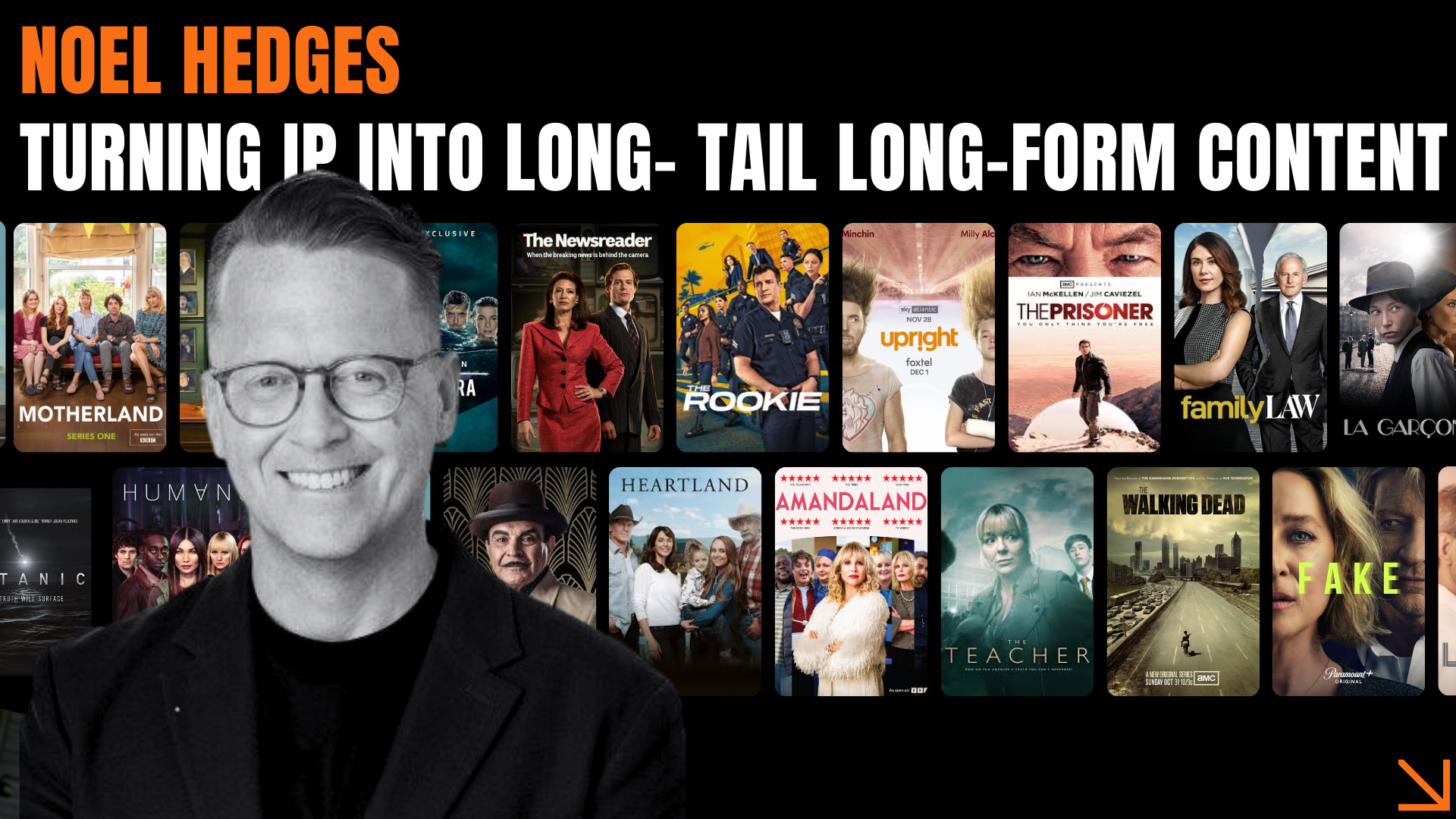
So I'm going to do something rare: explicitly recommend someone. I never do this. I'm not an agent or diary service. And yes, there's nepotism involved - but we didn't leave the mean streets of Eccleston supercharged with contacts, so at the very least I can keep it in the family.
My brother Noel Hedges has just left Lionsgate after 8 years. Before that: major roles at ITV, BBC, and Shine - all that time spent deep in international scripted content, developing, acquiring, and financing drama, entertainment, and factual projects designed for global audiences.
For years, I couldn't articulate what Noel actually does. Does anyone really know what their sibling does? But we've been comparing notes recently, and it turns out he's perfect for this moment: he works at the intersection of premium scripted content, brands, and modern distribution.
He helps creative producers and IP owners figure out how to make the most of what they've got. Not just "let's make this once and hope" - but building a proper strategy around IP that can work in multiple ways, for multiple partners, across multiple markets. He draws on decades of international commissioning, financing, and distribution experience to help shape content, partnerships, and funding that give scripted projects a longer life.
If you're a production company sitting on scripted IP you want to exploit properly, or a brand looking to create entertainment that actually travels, or an agency wanting to understand how to structure these partnerships - this is the expertise you need.
Get in touch and I'll make the introduction.
3. Producer Presentation
3. Producer Presentation
If I can only share ONE top tip for producer candidates this year to get more job interview…it’s to up your presentation game.
Sort your CV, your Linkedin. develop your network for sure: those get you in the room. But what gets you the offer is how you showcase your thinking, how you communicate, how you present things visually and in person.
Without question, on my jobs, the candidates who present a deck or case study in interviews have higher offer rates than those who just talk through their experience. Increasingly, interview processes include tasks or presentations as standard.
I know what you're thinking: "Great, another hoop to jump through."
But I honestly urge you to reframe it.
In a supply-heavy market as we have at the moment, showing your flair is your chance to control the narrative. Your CV got you in the door - it's done its job. Now you get to show aswell as tell. You get to demonstrate strategic thinking, communication skills, and how you'd actually approach the role and crucially how you convey your opinions and perspectives to stakeholders.
Then, once in the role, Producers who can create compelling presentations move faster on PPMs, can convey visual ideas quickly and with impact. They prep key meetings more efficiently. They spend less time outsourcing decks to designers. They communicate with stakeholders more effectively. Those producers are showing they can structure complex ideas, maintain influence and engagement, and build credibility. Surely The ability to synthesise information and present it with clarity isn't just for designers and creatives it's core to the role of a producer too. The ability to tell a story visually at a glance - whether that's storyboarding, layout for a deck, or visual references for a concept - is a superpower. Master it, and you're immediately more valuable than producers who rely entirely on words.
The most underestimated skill in production? Thumbnails. Seriously - when I was hiring producers muself if they couldn’t pick stand out thumbnails I’d keep looking.
If you're going for interviews in 2026, expect to do some sort of task or presentation. Don't resist it. Prepare for it as you'd prepare for a pitch. Make it an opportunity to showcase not just what you've done, but how you think and how you convey your “taste”.
And if you're currently employed but want to move up? Start building this muscle now. Volunteer to create the next client presentation. Build decks for internal meetings. Get comfortable with visual storytelling. Start with your CV and Profile - I can help, check out my guide just for producers in 2026.
4. Why 80% of producer CVs Are Failing
4. Why 80% of producer CVs Are Failing
If you're a freelance producer in 2026 and you're single-track - TVC only, for example - you're going to find it hard this year. That's not opinion. That's what my research shows.
The briefs I'm seeing ask for genuine hybrids:
Shoot production + stills/art buying + live action
Project management methodology + multi-channel delivery (not just execution)
Strategic thinking + client management + hands-on production + delivery/Project management
These aren't unicorns. They're the new baseline for senior roles.
The uncomfortable truth from my research: 80% of the CVs I receive wouldn't make it past an ATS (Applicant Tracking System), never mind get an interview for these new types of roles.
They read like project lists rather than demonstrating impact. They bury hybrid skills instead of leading with them. They use language that doesn't match what job descriptions are searching for. And most damningly, they don't tell a story about versatility and strategic value.
If you don't know what an ATS is, you're already at a disadvantage. It's the software that screens CVs before a human sees them. It looks for keywords, structure, and relevance. Most producers have no idea their beautifully designed CV is getting rejected by a robot before anyone reads it.
What I'm seeing about hybrid skills:
Producers with multiple skill combinations are getting offers 40% faster
Hybrid capabilities command 15-20% salary premiums
Single-track specialists are experiencing longer job searches, even with strong experience
The market is rewarding versatility. Specialist knowledge is valuable, but hybrid capabilities are essential. If you’d like a free quick opinion on your CV take my QUIZ. so I can understand your strengths, ambitions, and the producer roles that'll actually suit you. It helps me match you with the right opportunities and I’ll feedback with any ideas!
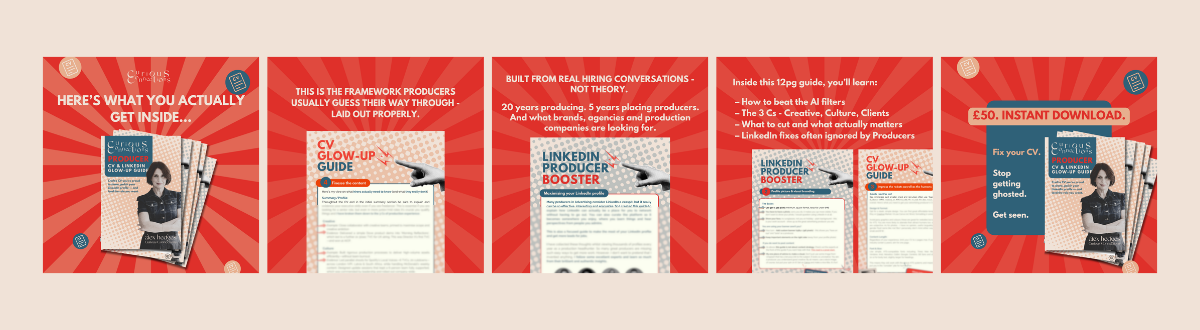
This is exactly why I created the Producer CV and Linked in Glowup Guide. It's not generic CV advice. It's based on analysing thousands of CVs against what actually gets interviews. It's intelligence translated into practical action.
Because your experience deserves to be seen. But first, it needs to get past the bots!
5. The Production Model - what's the difference?
5. The Production Model - what's the difference?
In-house at agencies. In-house at brands. Independent Roster Based Production Companies. Branded content specialists. Portfolio freelance careers. Production Consultants, The production landscape is evolving fast, and there's movement in all directions.
They're all my clients. I know there is a lot of controversy in the industry during this transition - business models are being tested, structures are shifting, and the old certainties about "the right way" to organise production don't hold up the way they used to. I’m not here to say one is neither good nor bad. It's just the reality.
What this means when you're hiring:
In a shifting landscape, clarity wins. When you're clear about what you're offering, you attract people who actually want that. When you're vague or aspirational, you end up with mismatches that hurt everyone.
As a hiring manager before you write the job spec or start searching, ask these questions:
What are we actually offering? Not what we aspire to be, but what the day-to-day reality looks like
What kind of production flow do we have? Constant flow or peaks and troughs?
Where does this role sit in our structure? Who do they report to? Who are their stakeholders?
What's the real split between strategic/creative/development work and execution? Be honest about this…is it sales?
What kind of producer will actually thrive here? Not just succeed, but genuinely thrive
Are we set up to retain this calibre of talent long-term? Or are we a stepping stone?
The producers with options - the ones you want - are making informed choices about where different models can take their careers. Companies that can give them an accurate picture self-select appropriately.
The bottom line
The production landscape in 2026 is complex, fragmented, and moving fast. We can navigate it with anecdotes, jargon and hope, or we can navigate it with systematic research and insider knowledge.
Whether you're an employer trying to build a team. or a producer planning your next move, or a freelancer wondering which skills to develop, you need intelligence, not guesswork.
I don't just fill roles, I provide strategic production insight, built on deep insider knowledge and ongoing research. I give you the information you need to make lucrative decisions.
Let's talk.
The first conversation is always curiosity, not transaction.
This post is based on ongoing research conducted across 500+ conversations with producers, creative teams, production companies, agencies, and brands between 2023-2026.