
What’s your Process? How I Recruit Advertising Producers, from First Call to Hire.
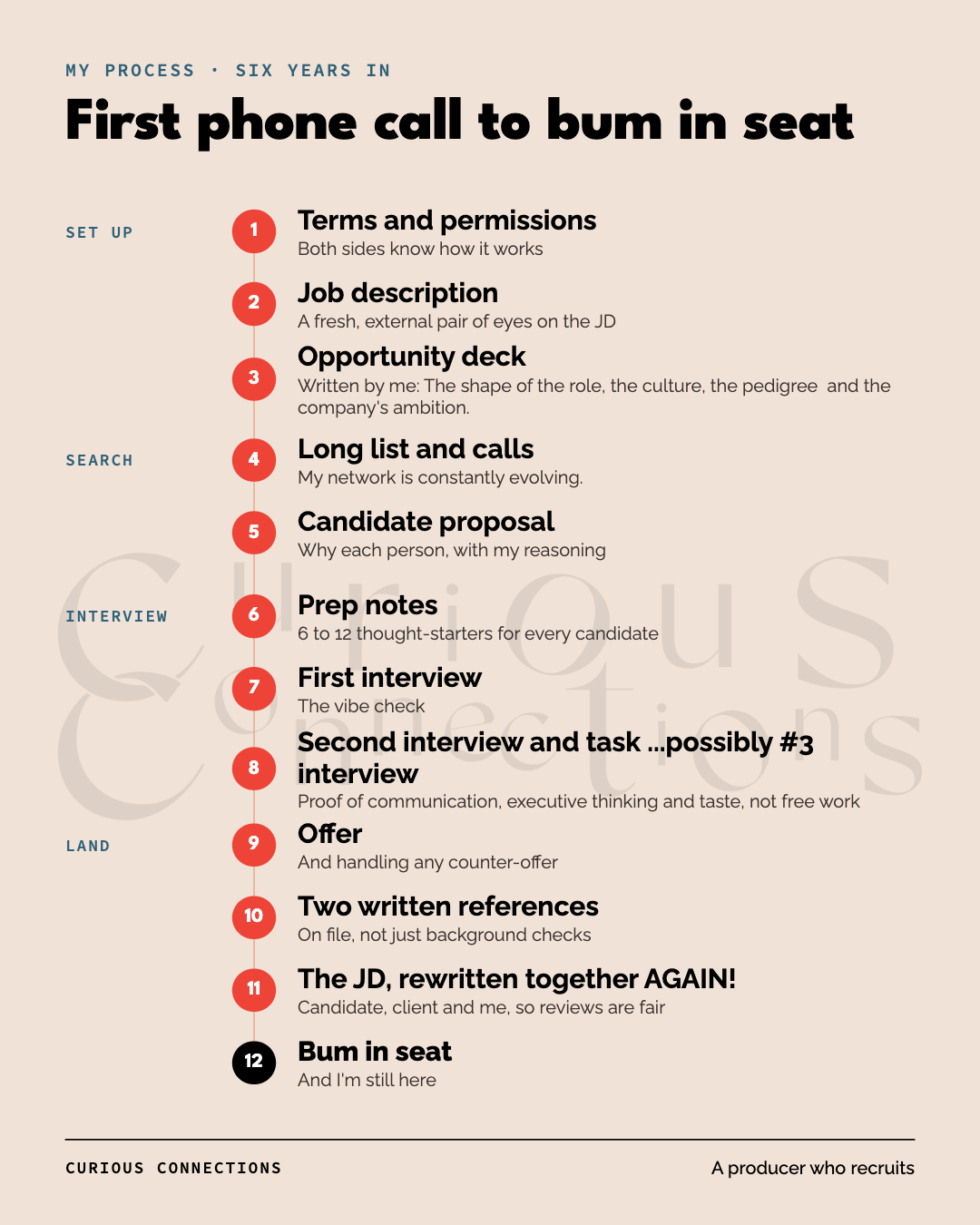
When a company gets in touch about a producer role, one of the first things they ask me is, "What's your process?" Before I started headhunting producers for agencies, production companies and brands, my answer would have been "find a candidate, get them hired", said with a bit of a shrug, because that's all I thought recruiting involved. Six years in, it turns out I do have a process. I think it's uniquely mine and it's a lot more involved than I realised, so here it is, from first phone call to bum in seat.
Before anyone sees a name: the brief, the JD and the opportunity deck.
Everything starts with paperwork, not the most exciting opening, but it matters just like any production. And I do treat all my work as a production; it's in my blood now. You as the company representative sign my terms and conditions and my permissions form, so we both know exactly what we're doing, how things work and a reasonable level of confidentiality is adopted by both sides.
Then I draft a job description. If you've already got one, I'll use it as my starting point, and I send mine back to you. You can completely ignore it, of course, but no one ever does; I think having a fresh external pair of eyes on the JD is really useful. Not least because a lot of companies just rehash the old version and that's a missed opportunity in my opinion
The bit I'm proudest of comes next, and I call it the opportunity deck. It's a formatted articulation of the role and the company, an objective one but I write it. I research the business, and I ask you what you're looking for in terms of fit, what your goals are, what success looks like and what went wrong in the past. If you're replacing someone, I want to know what you'd like to do differently this time.
None of that goes into the deck explicitly. What it does is colour everything, so the deck shows the shape of the person you need and the shape of the company's ambition. Most job descriptions have a little summary at the top at best, and more often than not it's the "about us" section cut and pasted from LinkedIn. The Curious Connections opportunity deck is about explicit priorities, references, ambitions, pedigree - the things that make good producer candidates lean in.
I've done one for every role this year without exception, and candidates keep saying: "Oh my god, I didn't know the company was like that", "it's way more interesting than I thought" and "I wouldn't have gone for it if they hadn't told me all this" . I don't think other recruiters do this, and I'm certain LinkedIn job ads don't, because they don't paint the opportunity. One day I'd love to film my clients talking about what they're looking for, and make it a little clip to share - not sure who's game, though!
How I measure my success:
Retention: the people I place stay, and grow into the role.
Repeat business: clients come back for the next search.
Thriving clients: the team is stronger for the hire.
Finding the people: headhunting senior producers.
I've got an extensive database and I'm talking to producers all the time. Most weeks I speak to 10 to 12 producers I haven't spoken to before, I check in on previous candidates, and I talk to production leaders who might entertain a move. From all of that, I build a long list.
Then I book a whole load of calls and go through it at a high level. I look at the CVs, but when candidates are going through me, it's more about my summary of the candidates' offerings that matters. However, if one is truly terrible, five pages long in a Word document and about to embarrass its owner in front of a client, I'll redo it for them.
What sells candidates is not so much their CV but my " candidate proposal". It explains why I've chosen each person, what the range across the shortlist is about and what I'm hoping you'll get out of the meetings. Each candidate gets a slide with their headline benefits, a summary of their experience, why I think they're good, their salary and their notice period, so you get my reasoning along with the names.
Holding the process:
Once we're live, all the comms come through me, and I'm quite firm about it. Don't go rogue.
I know that can sound controlling, but again It's just like producing: you wouldn't want the director calling the CPO without you knowing about it, and I don't want that happening here either. It's how I keep hold of the process so everybody, candidates and clients, gets what they want out of it.
Getting candidates ready for interview:
Before anyone goes into an interview, I'll have spoken to every candidate at least twice, and every one of them gets prep notes from me. They're built around where their gaps are, so they can think about how to fill them, and where their strengths are, so those come to the front.
I do this because these conversations can easily turn into nice production chats where everyone forgets to sell themselves or just talks about "the state of the industry". I don't want to turn anyone into a car salesman either, so it's a balance but I give them 6 to 12 thought-starter questions, and a call to talk them through if they want one.
Their notes aren't a script to learn. Just looking at the questions and thinking about them puts everything at the front of their mind, so they can recall it in the room when it's asked. Saying you went to Prague and did a 10-day shoot, whilst name-dropping some industry contacts, is all very well and good, but when you're interviewing for a production role you need to be able to talk about the challenges and how you overcame them.
Interviews and hiring tasks:
The first interview is mostly the vibe check, and a lot of companies come out of it saying "yay, great, let's just hire her/him/them". But I absolutely caution against that. There's almost always a second interview, and you need to speak to options and take all of them for a drive!
Often there's a task to do after. It evolves with every role and it's always crafted in partnership with the company hiring. "Good written communication skills" is in almost every job description, but how do you know? You've met them once, and you haven't seen anything they've written apart from, potentially, a very badly written CV. Creative taste is hard to define, but in the context of a particular agency, brand or production company, it should be quite clear what you mean, and a task is a chance to prove it, right down to the thumbnails someone chooses for a deck.
What I don't think clients should ask for is full strategies and SWOT analyses. Some bigger companies do, and at that point you're at risk of asking people to do free work. Candidates can talk proactively about the areas they'd like to develop, and that's where the opportunity deck and all those earlier conversations pay off.
I'm not keen on candidates presenting either, because it becomes death by PowerPoint. Candidates and clients need to be focused on each other, reading body language and getting a sense of how the other person communicates, and every time they break to look at a slide that's lost. If there's a document, send it before and discuss it, or send it after the discussion.
Some candidates find all this a lot: "I've got to do another thing, and then another thing, they want a lot." NOTE TO EVERYONE: Often that's because I pushed for it, it's not the company. I am a massive nana about this stuff, but that's why my retention rate is so high. I get much more face time with candidates than the client does, and much more room to ask candid questions and push back, so if I'm not convinced yet, I don't want them going in there and failing, for anyone's sake, not least my own reputation. Of course I don't know each company like those doing the interviews, but I have worked in hiring roles at most of the production settings myself, i know the benchmarks for a good hire.
The offer, counter-offers and references:
Then we offer someone the job and everyone thinks we've cracked it, when honestly it's almost like starting again.
So many companies counter-offer now. I tell every candidate, and I mean it, that turning a job down won't damage their relationship with me and I'll handle it without burning any bridges. But I'm really anti the counter-offer. It rarely changes anything beyond a few more quid and a job title, and every candidate who has taken one in the last 18 months has called me six months later to say they should have listened to me and left - because nothing materially changed.
Whatever happens, I handle the offer and any counter directly between the candidate and the client. Then I make sure there are two written references; that's not to be missed. The actual references need to sit on file for legal reasons, not just background checks
Then I do the thing that surprises people most, which is REWRITE the job description AGAIN, this time with the candidate and the client input. Over the course of all those meetings, the goals may have evolved, and so may what this person can bring to the role, so it needs to be really tight, because as far as I'm concerned, that document forms part of the contract. In a year's time, when you sit down to do their review, that's what you'll both be looking at, and if you say "you haven't changed any of our processes " when nowhere does it say they're responsible for changing the processes, that isn't a review; that's moving the goalposts.
Standing people down
This is the hardest part for me. By the end of a search I'm properly invested in every candidate, especially the last two, because I've spent weeks in the weeds with them and I know how much they've put in. But there's only one job.
I stand people down myself, honestly and with real feedback, and I often suggest the client drops them an email too. If you were in the last two, you were in the last two, and I won't dress it up. It's always a shame, but it's always worth doing properly, because companies grow and production arms expand, and the person you turn down this month could be the one you come back for next year. In an industry this small, they could even be your supplier or your client.
What happens after a candidate starts.
If it doesn't work out, I need to hear from both sides what changed, because it could be chemistry, a lack of management rigour, a lack of structure or a lack of communication, and it could be both sides. And as per my terms and conditions, I offer a rebate schedule. In six years, I've given a partial refund once
An Exec Producter -level search in numbers:
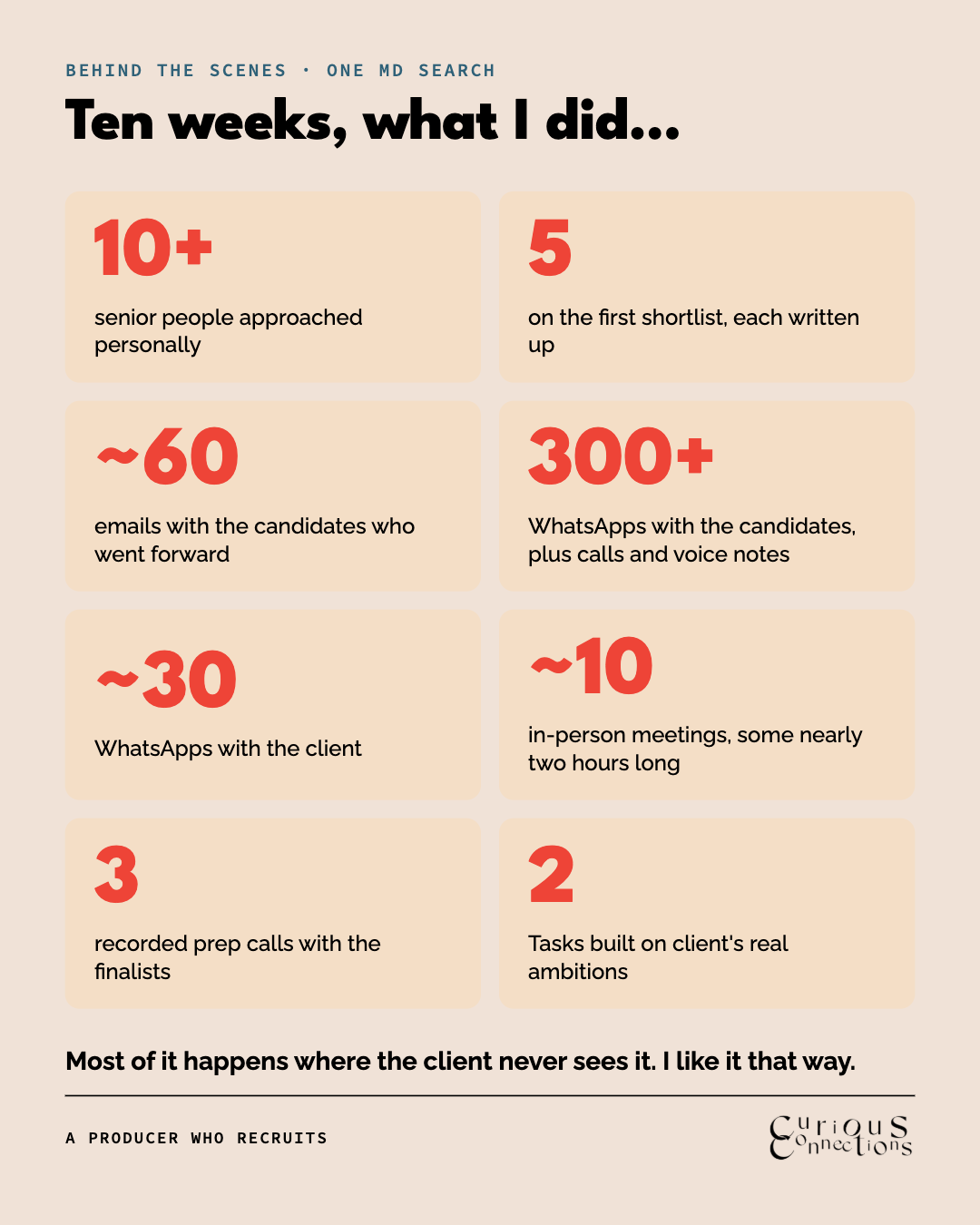
People don't always believe me when I say how much goes into this, so I audited a recent MD-level search, ten weeks from the intake call to the final meetings. The counts come from my inbox, my calendar and WhatsApp, so they're approximate, and if anything they're on the low side.
What I do so you don’t have to
It starts with a call but it doesn’t end with just a hire.
More than 25 senior producers approached personally, most of whom would never have answered a job ad
A first shortlist of 5, each written up with why I rated them and where they'd need support
Around 60 emails and more than 300 WhatsApps with the candidates who went forward, plus the calls and voice notes in between
Around 30 WhatsApps with the client
Around 10 in-person meetings with the leadership, several of them close to two hours long
3 recorded prep calls with the finalists, transcribed so they had the notes afterwards
1 CV rebuilt from scratch in an afternoon. Reformat 2x candidate presentations
NDAs signed and returned, meetings scheduled, changed, scheduled again.
Most of that happens where the client never sees it, I don't need them to.
Why do all that?
Other recruiters don’t do all that - People ask me why I do all of this, and why I seem to do everybody's job. As a producer, it is my job to do everybody's job. My reputation is built on it, and I couldn't work any other way, I just wouldn’t believe in myself.
Alex Hedges founded Curious Connections after 25 years in production, from runner to MD, at Mother, BBH, Saatchi & Saatchi, RSA, Stink and Outsider. She now headhunts producers for agencies, production companies and in-house brand teams. More about me